Using AI to fight AI
- Mazvita Velah
- May 5
- 2 min read

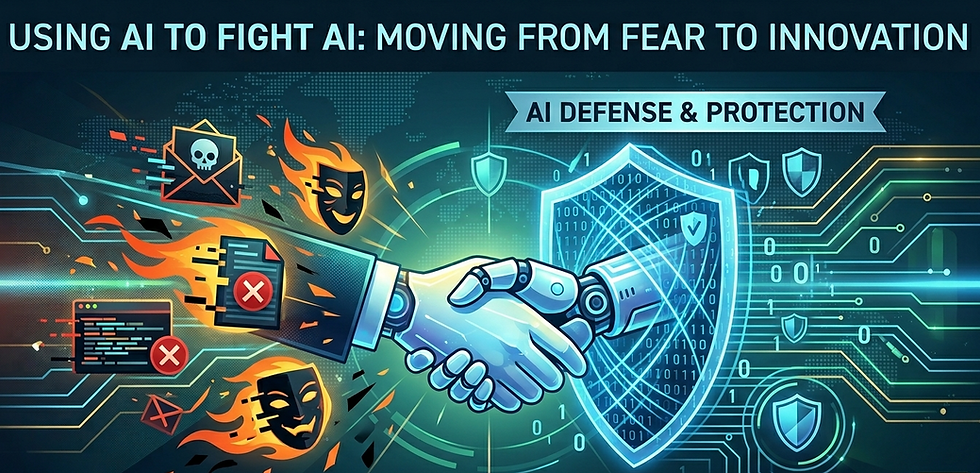
During a Leading Technology lecture last week, I shared an idea that has really changed how I look at things. It is a phrase I first heard at the Zywave Casualty Insights Conference: "We need to start using AI to fight AI." Thinking about those words made me realize that many of us spend so much time worrying about the risks of AI that we sometimes forget we can actually use it to protect ourselves. For years, we have mostly talked about the fear that AI might take our jobs or be used to hack our systems. Because it was so easy to see AI as the "villain," we stayed on the defensive, but I truly feel that things are finally changing.
I have started to picture this as a digital battlefield, a high-pressure contest where we use smart technology to stop those who want to cause harm. Imagine a "bad actor" using one AI to write a perfect, fake contract that looks completely real to any person. On the other side, we can now have a defensive AI scanning that same text. It looks for tiny digital fingerprints that the human eye could never catch. In a world this complex, where threats move faster than we can think, we have reached a point where we really have to trust "good" AI to help us stay safe. We are moving past the era of fear and into the era of Agentic AI, where our own smart programs act as our first and most reliable line of defense.
We are already seeing this in action through some really encouraging examples. For instance, while some people might use AI to create deepfakes to trick others, companies have developed AI tools that scan for tiny mistakes in skin patterns or voice tones that a person would miss. Another example is how AI helps catch "ghost" phishing. Even if a "bad" AI writes a perfect email without a single typo, a defensive AI can recognize if the message does not fit a person's pattern of life or their usual way of speaking. It blocks the message before it causes any trouble.
Finally, we are using AI to stop polymorphic malware, which is a type of virus that constantly changes its own code to stay hidden. Instead of just looking for a known file name, behavioral AI watches how a program acts and shuts it down the moment it starts behaving like a virus. To really make a difference, we cannot just rely on basic tools; we need specialized systems filled with industry knowledge that truly understand specific risks. Rather than feeling like victims of new technology, we have the chance to be innovators. Our goal now is simple: to make sure the AI on our side is faster, smarter, and stronger than the AI being used against us.



Comments